
HOA Community Emergency Weather Alerts: How NWS and FEMA Integration Protects Every Resident
Homeowners associations manage more than landscaping schedules and pool rules. When a tornado warning drops without notice, a flash flood evacuation order covers three streets in the community, or a wildfire moves faster than local news can report it, the HOA board becomes the last line of communication between official emergency guidance and the people living inside the gates.
Most HOA boards are not equipped for that responsibility, not because they don't care, but because nobody ever gave them the tools to handle it. The city sends a reverse-911 call that half the community misses. The neighborhood Facebook group erupts with conflicting information. Someone posts a screenshot of a weather radar that is already 20 minutes old. Meanwhile, the National Weather Service has already issued a formal evacuation order that residents have no reliable way of receiving at the community level.
This is the gap that ReadyAlert's HOA community emergency weather alerts integration was built to close, and for HOA communities specifically, it is one of the most operationally significant features available at any price point.
Why HOA Community Emergency Weather Alerts Fall Short Without the Right System
Homeowners associations occupy an unusual position in the emergency communication landscape. They are private communities with defined boundaries, known membership rosters, and a board that has both the authority and the responsibility to communicate with residents. But they are not government entities, so they are not plugged into official emergency broadcast systems. And they are not large organizations, so they typically have no dedicated communications staff.
What most HOA communities rely on in a weather emergency is some combination of community email lists, social media groups, door-to-door notification by volunteers, and whatever the local emergency management system pushes out to the general public. None of these are fast enough, targeted enough, or reliable enough for the scenarios that matter most.
A flash flood warning has a window of minutes, not hours. A tornado watch becoming a tornado warning in real time requires immediate action from residents, take shelter, move to an interior room, do not use elevators, and the message has to reach every resident simultaneously, not sequentially through a chain of phone calls and forwarded emails.
The specific challenges HOA communities face in weather emergencies follow a consistent pattern.
Official alerts don't reach residents at the community level. National Weather Service warnings and FEMA evacuation orders are broadcast through the Emergency Alert System, television, radio, and wireless emergency alerts on mobile phones. But wireless emergency alerts are geographically broad, often covering entire counties. A resident whose phone buzzes with a county-wide tornado warning has no way of knowing whether that warning applies to their specific neighborhood, development, or elevation. Community-level context is missing entirely.
HOA communication tools are built for routine, not emergency. Most HOAs use email newsletters, community management platforms, or neighborhood apps for regular communication. These tools work fine for announcing pool hours or collecting dues. They are not designed for the speed, multi-channel delivery, or delivery confirmation that a genuine weather emergency requires. An email sent at 11:47pm during a flash flood warning will not be read in time by a resident who is asleep.
There is no confirmation of who received the message. When an HOA board member sends an emergency email or posts to the neighborhood Facebook group, they have no way of knowing who received it, who read it, and who is still unaware. In an evacuation scenario, the residents who did not receive the alert are exactly the people who need a follow-up, and without confirmation data, there is no way to identify them.
Language barriers leave some residents unreachable. In communities with multilingual populations, English-only alerts reach only part of the community. The residents least likely to be plugged into informal neighborhood communication channels are also often the residents who most need official-language alerts in their primary language.

How ReadyAlert's NWS and FEMA Alert Integration Works in an HOA Setting
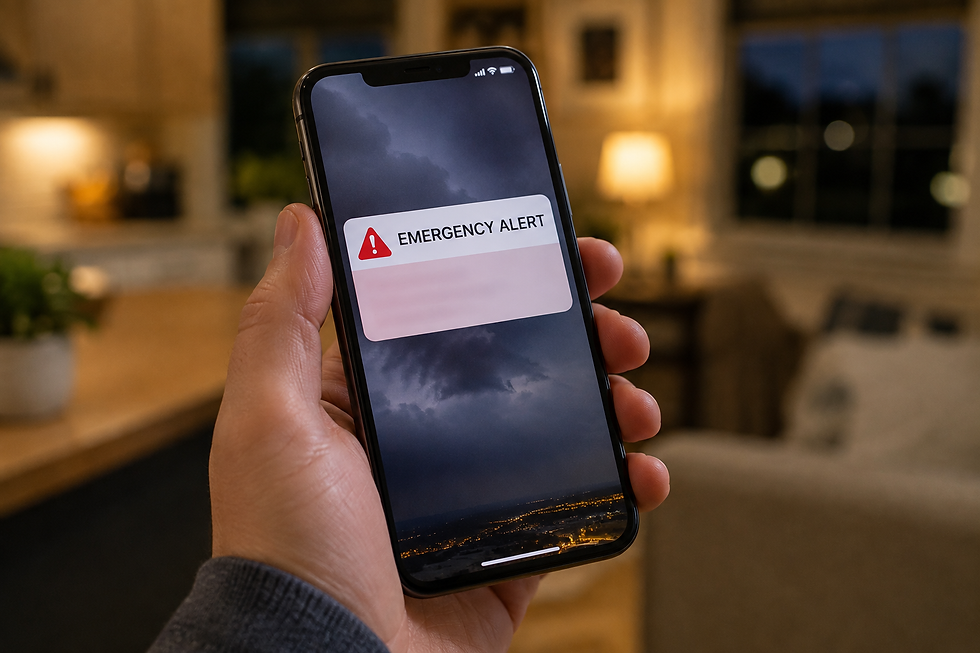
ReadyAlert's weather alert integration connects directly to the National Weather Service and FEMA's official alert feeds. When a qualifying weather event, tornado warning, flash flood emergency, winter storm warning, evacuation order, or other designated alert type, is issued for the geographic area that covers the community, ReadyAlert automatically triggers a simultaneous notification to every registered resident through SMS, voice call, email, and WhatsApp.
The HOA board does not have to monitor weather radar. They do not have to be awake at 2am when a severe thunderstorm watch escalates to a tornado warning. The system monitors official NWS and FEMA feeds continuously and fires the alert automatically the moment a qualifying event is issued for that location.
Here is what that looks like in a real scenario.
A Thursday evening in late spring. A slow-moving storm system produces conditions favorable for tornadoes across a three-county region. At 9:14pm, the National Weather Service issues a tornado warning for a specific polygon that includes an HOA community of 340 homes. At 9:14pm and 22 seconds, ReadyAlert fires simultaneous notifications to every registered resident: an SMS message with the official warning text and the recommended action, a voice call for residents who do not have their phones visible, and an email with extended detail including shelter-in-place instructions and the NWS source link.
By 9:15pm, every resident who has registered their contact information has received the alert through at least one channel. The board president does not have to make a single phone call, compose a single message, or be anywhere near a computer. The system handled the entire chain from official issuance to community delivery in under 60 seconds.
Two-way confirmation closes the accountability gap. When residents receive the alert, they can reply to confirm receipt, and the board has a live dashboard showing exactly who has confirmed and who has not responded. In an evacuation scenario, this data is operationally valuable: the board or a designated safety coordinator can prioritize follow-up outreach to the non-responders, focusing human effort precisely where it is needed rather than making redundant calls to residents who are already aware and moving.
Language Translation reaches every resident. For HOA communities with Spanish or French-speaking residents, ReadyAlert's Language Translation add-on delivers the same alert in the resident's configured language simultaneously with the English version, no separate workflow, no delay.
What This Looks Like for an HOA Board in Practice
The operational reality of managing this system day-to-day is simpler than most board members expect. Setup requires three things: loading the community's resident contact roster into ReadyAlert's group structure, configuring the geographic boundaries for NWS/FEMA alert monitoring, and defining which alert types trigger automatic community notification.
Once configured, the board's ongoing involvement in weather emergencies is minimal by design. The system monitors, triggers, and delivers automatically. The board's role shifts from active broadcaster to oversight function, reviewing confirmation data after an alert fires, following up with non-responders if the situation warrants it, and sending supplemental community-specific guidance (which evacuation route to use, where the community's designated shelter is located) through the same ReadyAlert platform they already know how to use.
For HOA communities that want to use ReadyAlert for routine communication as well, scheduled maintenance notices, amenity closure updates, community event announcements, the same platform handles both, at no additional complexity.
Getting started takes less than a day. Most HOA administrators complete the initial setup, loading the resident roster, configuring alert geography, and running a test notification, in under three hours. ReadyAlert requires no hardware installation, no IT support, and no long-term contract. The NWS/FEMA weather alert integration is available as an add-on to any ReadyAlert plan.

What It Costs - and What It's Worth
ReadyAlert's HOA and residential community pricing is straightforward:
$15 per home per year - core alerting with full multi-channel delivery, two-way confirmation, and all standard ReadyAlert features
$30 per home per year - includes NWS/FEMA weather alert integration and automatic community-level emergency broadcasts
For a community of 200 homes, the full weather-integrated plan costs $6,000 per year, or $500 per month. For a community of 100 homes, it is $3,000 per year. There is no per-alert fee, no per-message cost for standard alerts, and no additional charge for the delivery confirmation dashboard.
The more relevant comparison is not the monthly cost, it is the cost of the alternative. An HOA that relies on email lists and neighborhood social media during a tornado warning is not saving money on emergency communication. It is accepting liability exposure, resident trust risk, and the human cost of an avoidable notification failure, in exchange for a $500 monthly line item.
Most HOA boards, when they frame it that way, find the decision straightforward.
The Bottom Line
HOA community emergency communication has historically been an afterthought, handled informally, inconsistently, and with tools built for convenience rather than crisis. NWS and FEMA alert integration changes that equation fundamentally. It connects the official emergency broadcast infrastructure directly to the community's communication system, removes the human bottleneck from the most time-critical moments, and gives residents the same quality of emergency notification that large organizations and government entities have had for years.
ReadyAlert brings that capability to HOA communities of any size, at a price point that makes it one of the most cost-effective decisions a board can make for its residents.
Ready to see how it works for your community? Visit https://www.readyalert.com or call us at 888-689-8939. For communities actively evaluating the NWS/FEMA integration, our team can walk you through a live demonstration and build a pricing quote based on your home count.
Questions? Email us at sales@readyalert.com - we respond fast.
https://www.readyalert.com | 888-689-8939 | sales@readyalert.com
ReadyAlert™ Services, LLC - Critical Communications, Simplified!
Frequently Asked Questions
What types of NWS and FEMA alerts does ReadyAlert automatically broadcast to HOA communities? ReadyAlert monitors official NWS and FEMA feeds for qualifying events including tornado warnings, flash flood emergencies, winter storm warnings, severe thunderstorm warnings, and FEMA evacuation orders. The specific alert types that trigger automatic community notification are configured during setup based on the community's location and board preferences.
Do residents have to download an app to receive ReadyAlert notifications? No. ReadyAlert delivers alerts via SMS text message, voice call, and email, no app required. Residents with WhatsApp can also receive notifications through that channel if configured. The system reaches residents through the communication channels they already use.
What happens if a resident doesn't respond to an alert? ReadyAlert's two-way confirmation system shows the board exactly who has and has not responded to each alert in real time.
Can ReadyAlert send alerts in languages other than English? Yes. ReadyAlert's Language Translation add-on delivers alerts in up to 26 languages, natively French and Spanish, simultaneously with the English version, based on each resident's configured language preference. This is particularly valuable for HOA communities with multilingual populations.
How does HOA pricing work for ReadyAlert? ReadyAlert's HOA and residential community pricing is based on the number of homes in the community: $15 per home per year for core alerting, or $30 per home per year with NWS/FEMA weather alert integration included. There are no per-alert fees for standard alerts and no long-term contract requirement. Contact sales@readyalert.com for a custom quote based on your community size.


Comments