
The Anatomy of a Successful Emergency Alert: What Makes Messages Effective

When an emergency happens, the quality of your message can determine the quality of your response.
A successful emergency alert is not just about sending something fast. It’s about sending the right message, to the right people, through the right channels, at the right time, and doing it in a way people can immediately understand and act on.
Whether you’re protecting employees, students, residents, guests, or first responders, effective alerting depends on a few core principles. Get them right, and people respond faster. Get them wrong, and confusion spreads just as quickly as the incident itself.
What makes an emergency alert effective?
It is clear In a crisis, people don’t have time to decode vague wording. Strong alerts use:
Plain language
Short sentences
One obvious action
Location-specific details
Instead of: “Please be advised of a developing situation in the area”
Use: “Evacuate Building B now. Use the west exit and proceed to Lot 4.”
The first message sounds formal. The second saves time.
It is immediate
Speed matters because emergency situations evolve fast.
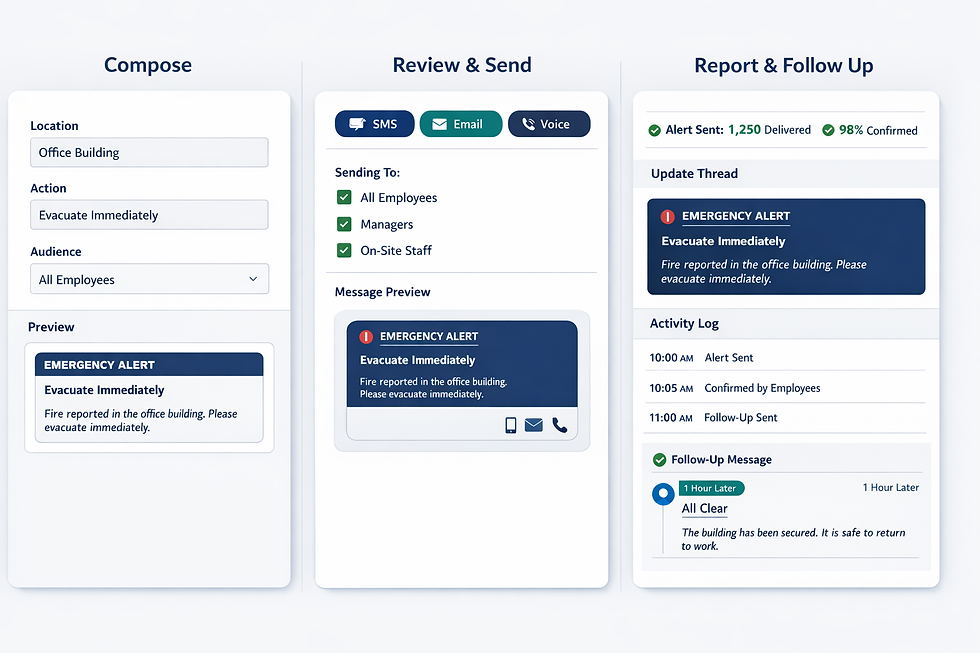
An effective system allows you to send an alert in just a few clicks, without having to build the message from scratch every time. Pre-written templates, quick dispatch buttons, and mobile access help reduce delay when every second counts.
In practical terms, that means:
Less time writing
Less time searching for contacts
Faster delivery to the people who need it most
It reaches people where they already are
One channel is never enough.
People may miss a text, overlook an email, or be unable to answer a phone call in time. That’s why effective alerts use multi-channel communication, typically SMS, email, and voice, so the message has multiple chances to get through.
This kind of layered delivery helps ensure that people:
Receive the alert
Recognize it as urgent
Know they received the message
That last point matters more than many organizations realize.
It is targeted
Not every emergency requires everyone to receive the same message.
A strong alert is often role-based, location-based, or event-based. That means the right people get the right message without overwhelming everyone else.
For example:
Maintenance may need a utility failure alert
Security may need a lock-down notification
Staff may need a weather warning
A specific building may need an evacuation order
Targeted messaging reduces confusion and keeps recipients focused on what actually applies to them.
It includes a specific action
An emergency alert should tell people exactly what to do next.
The message should answer:
What is happening?
Where is it happening?
What should I do?
When should I do it?
Without a clear next step, even a fast alert can fail.
Examples of strong action statements:
“Shelter in place immediately”
“Move to the assembly area behind the gym”
“Do not enter the east wing”
“Await further instructions”
The best alerts leave no room for interpretation.
It uses a consistent structure
When people are stressed, familiar structure helps them process information faster.
A good emergency alert often follows this simple pattern:
What happened
Where it happened
What to do
Who is affected
What happens next
That structure helps the brain organize the message quickly and reduces the chance that people miss a critical detail.
It confirms delivery and response
Sending an alert is only part of the job.
You also need to know:
Who got the message
Who opened it
Who responded
Who still needs follow-up
Confirmation and reporting are essential because they give incident leaders visibility in real time. That allows for escalation if someone hasn’t responded and helps teams verify that critical recipients were reached.
This is especially important in environments where accountability matters — schools, healthcare, industrial facilities, municipalities, and large campuses.
It supports follow-up communication
Emergencies rarely end with one message.
The best systems make it easy to send updates that stay connected to the original alert. That way, recipients can follow the full thread of the incident instead of receiving random, disconnected messages.
Examples:
Initial alert
Status update
All-clear notice
This kind of continuity reduces confusion and keeps everyone aligned as the situation develops.
Common mistakes that weaken emergency alerts
Even good organizations make avoidable mistakes when crafting alerts.
Too much information
Long messages slow people down. If everything is urgent, nothing stands out.
Too little information
If a message says only “Emergency in the building,” people won’t know what to do.
No location detail
Without location context, people may panic or respond in the wrong way.
Using internal jargon
Terms that make sense to staff may confuse guests, patients, parents, or contractors.
No confirmation
If you can’t verify receipt, you’re guessing about readiness.
What a successful alert system should support
A well-designed emergency communication platform should make effective messaging easy. That usually means:
Pre-built templates for common incidents
Quick dispatch options for speed
Multi-channel delivery
Role- and group-based targeting
Delivery confirmations and reporting
Mobile, desktop, and tablet access
Security controls for large sends
In other words, the platform should help users send a message that is both fast and trustworthy.

A simple formula for better emergency alerts
If you want more effective alerts, use this formula:
Who + What + Where + What to do
Example:
“Employees in Warehouse 3: smoke detected near loading dock. Evacuate now and report to Muster Point A.”
That’s short, direct, and actionable. It doesn’t waste time.
The bottom line
A successful emergency alert is not just a notification, it’s a decision-making tool.
The best messages are clear, fast, targeted, and easy to act on. They reach people through more than one channel, confirm delivery, and support follow-up as the incident changes. When your alerting system is built around those principles, your team can respond with confidence and speed.


Comments